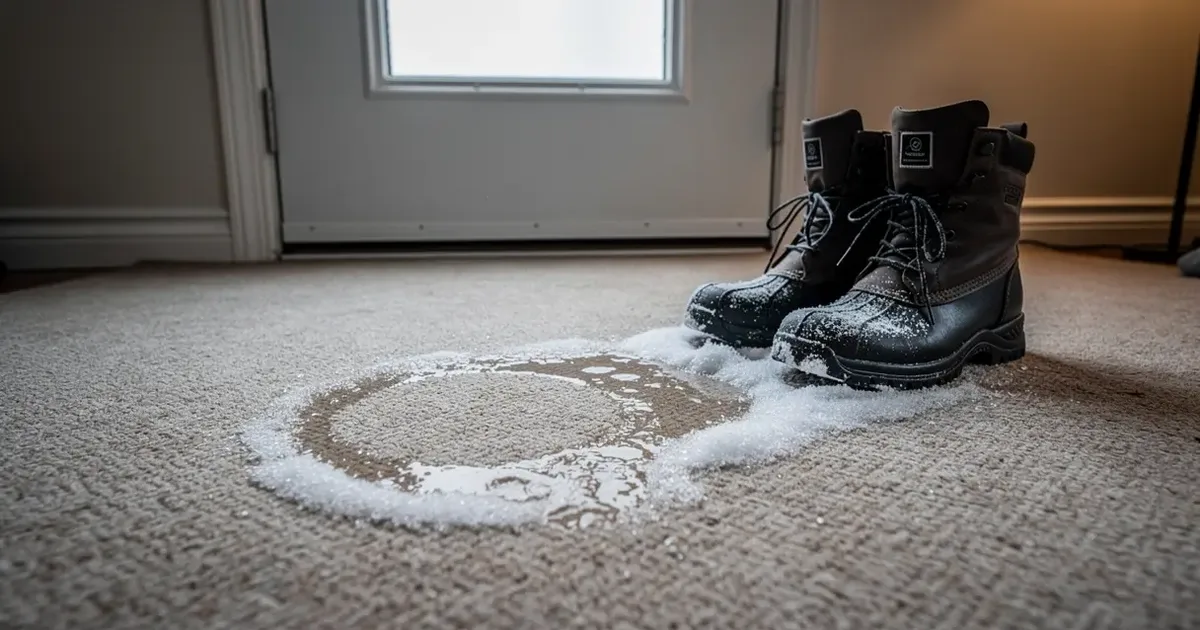
In winter, a white crust often shows up on the carpet near the front door. It comes from the salt and calcium that boots carry in from the sidewalk and the parking lot. Before you scrub or wet it, a few simple steps limit the mark, and a few others make it worse.
The advice below applies to wall-to-wall carpet and to an entrance rug alike. For a full cleaning, our page on carpet cleaning in Sherbrooke presents the service.
Where the white marks near the entrance come from
Sidewalks, parking lots and driveways mostly receive two de-icers: road salt, which is sodium chloride, and "calcium", which is calcium chloride. They do not behave the same way. Calcium chloride is hygroscopic, meaning it absorbs moisture from the air. Sodium chloride leaves a dry surface covered in salt.
On a carpet, that gives two kinds of marks. Salt dries into a white crust or ring. Calcium can keep the area dark, or slightly damp to the touch, for longer.
The marks follow the path of the boots: the entrance, the hallway, the bottom of the stairs, the door to the garage. Melted snow can carry salt a little past the sole itself. Spotting that path tells you where to focus the upkeep until spring.
The first days: blot, let it dry, then vacuum
When melted snow lands on the carpet, blot it with a clean, dry towel, pressing without rubbing. The less water that stays, the less dissolved salt sinks toward the base of the carpet.
Then let it dry. Once dry, salt goes back to being a deposit that a vacuum can pick up. To remove salt from a carpet, the Carpet and Rug Institute stain guide recommends vacuuming any dry spill first, to take up as much as possible. The same guide warns that pouring a liquid on a dry spill can create other problems (consulted in October 2026).
Vacuum slowly over the marked area, in several directions. If a crust stays stuck to the fibres, loosen it gently with a soft-bristle brush, then vacuum again. On a wool or long-pile rug, go even more gently and do not insist.
Some marks may remain after these steps: a pale ring, an area that feels rough to the touch or a slightly dull colour. They may mean that some of the salt has settled deeper than a vacuum reaches. The carpet is not lost. At this point, you know whether the mark stayed on the surface or needs more.
What is better avoided
A few common reflexes do more harm than good to a carpet marked by salt.
- Soaking the area. A lot of water dissolves the salt and carries it toward the base of the carpet, sometimes down to the underlay. As it dries, the salt can rise back to the surface and form a ring larger than the original mark. Our article on renting a machine or hiring a professional explains the risks of an over-wet carpet.
- Scrubbing hard. Scrubbing spreads the mark and can rough up the fibres. The Carpet and Rug Institute advises working gently instead, without scrubbing, from the edge of the stain toward the centre.
- Trying several products in a row. A homemade mix or a store-bought stain remover may suit one fibre and discolour another. If you want to try a product, test it first in a hidden corner, as the same institute recommends, and note what you used. That information helps choose the treatment if a cleaning becomes necessary.
- Letting the salt build up until spring. Salt left in place is walked on every day. Vacuuming the entrance often limits how much builds up.
Keeping salt at the door until spring
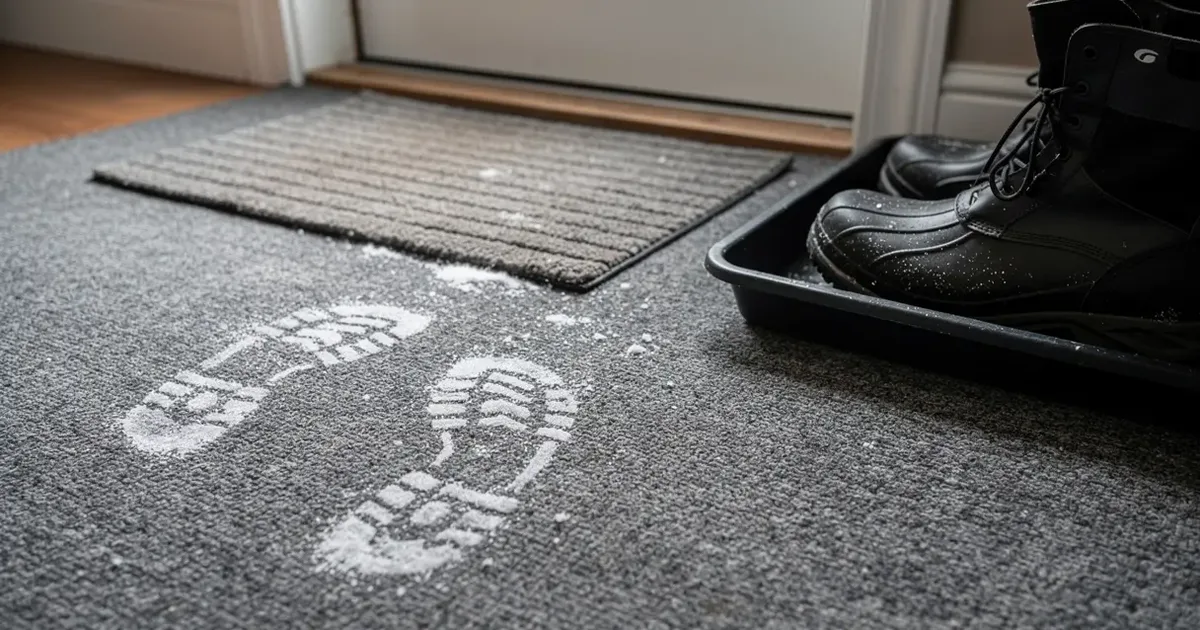
The simplest way to limit marks is to stop the salt before it reaches the carpet. In its commercial carpet maintenance standard (CRI 204), the Carpet and Rug Institute recommends mats outside and inside entrances, including absorbent mats inside to hold moisture. The same standard asks for mats to be cleaned more often than the carpet: a saturated mat holds nothing back (consulted in October 2026).
The document is aimed at businesses, but the principle holds for a home entrance too. At home, that comes down to a few habits:
- a scraper mat outside and an absorbent mat inside;
- a boot tray near the door, so melted snow drips somewhere other than the carpet;
- boots off as soon as people come in, visitors included;
- a pass with the vacuum in the entrance several times a week in winter, with the mat shaken out or vacuumed just as often.
Our article on how often to clean gives benchmarks for the rest of the year. With these habits, less salt reaches the carpet, and what does get through is more likely to stay on the surface, where the vacuum picks it up.
When to ask for a cleaning, after the thaw
If the mark is still visible after drying and several passes with the vacuum, some of the salt is probably in the base of the carpet. A cleaning can also be worth it when the mark spreads along a whole hallway, when it comes back after every home cleaning or when the piece is a wool rug.
The most useful time is the end of winter, when boots no longer bring in salt. A cleaning done in January can be followed by new marks with the next storm. If the mark bothers you sooner, it can justify a cleaning earlier.
Before we start, we look at the fibre, how far the marks spread and what has already been tried on it. That decides the method and how much water we use. We also tell you what may stay. Some salt marks come out completely and others only fade, especially when a product has already been applied or the fibre has changed colour.
Our article on photographing a textile explains how to frame each photo. For an entrance, an overall view of the path of the boots and a close-up of the mark are often enough to follow how the mark changes.
Frequently asked questions
Should I wet a salt mark to remove it?
Not at first. Let the area dry, then vacuum slowly. According to the Carpet and Rug Institute (consulted in October 2026), a dry spill is removed by vacuuming first, and pouring a liquid on it can create other problems.
Why does a calcium mark still feel damp?
Calcium chloride absorbs moisture from the air. On a carpet, the area can stay dark or slightly damp to the touch longer than an ordinary salt mark.
Do all salt marks come out in cleaning?
Not always. Some come out completely and others only fade, depending on the fibre, how far the mark spreads and the products already tried. After we look at the carpet, we tell you what may stay.
When should I have a salt-marked carpet cleaned?
At the end of winter, when boots no longer bring in salt, unless the mark bothers you sooner. In that case, an earlier cleaning can be justified.