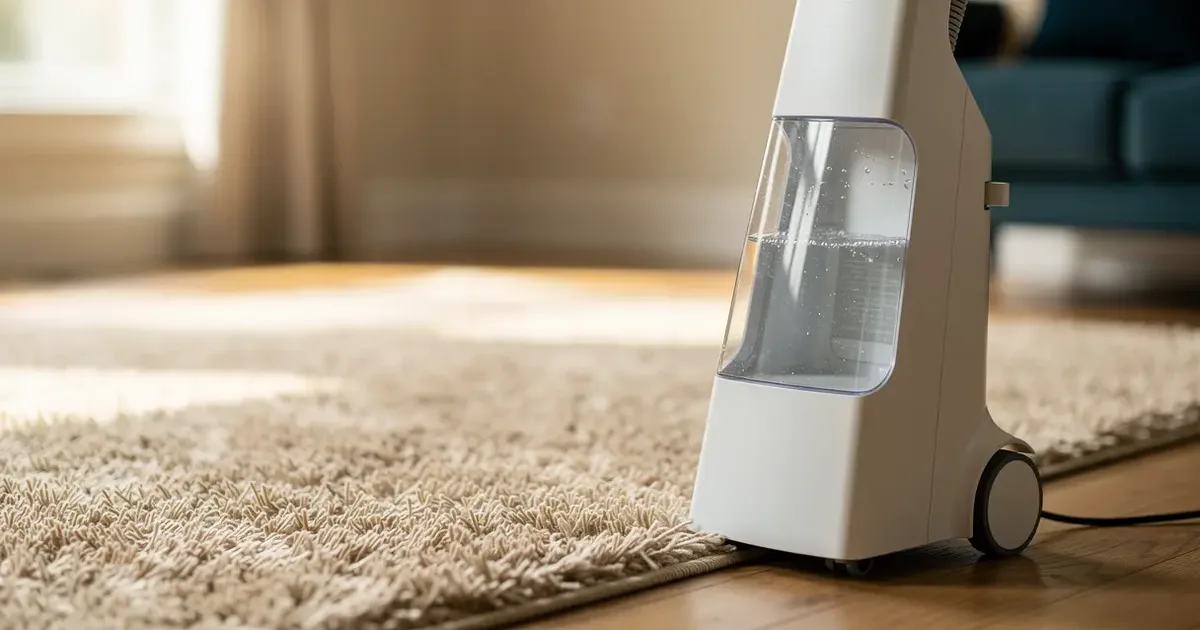
A rented carpet washing machine can freshen a lightly soiled carpet very well, as long as you use it methodically. Too much water or too much product can leave the carpet duller than before the cleaning. The Carpet and Rug Institute, the American carpet industry association, writes in its residential maintenance standard that these machines, available for rental, clean small marks and spills well but do not replace a periodic professional deep cleaning (accessed October 2026).
What a rental machine does well
For a lightly soiled synthetic carpet, a rental machine is often enough to freshen high-traffic areas and treat a fresh mark. It injects water and a product into the carpet, then sucks up part of that mixture along with the loosened dirt. Renting has real advantages:
- you choose the time that suits you, with no appointment to book;
- you can treat a single room, a hallway or just the entryway carpet;
- it revives a slightly dull carpet in a high-traffic area, when the dirt stays on the surface;
- it suits a maintenance cleaning between two deep cleanings, what the CRI standard calls an interim cleaning.
Used well, it is useful. The disappointments come mostly from how it is used.
The pitfalls of renting a carpet cleaning machine
Most bad surprises come from four mistakes: too much water, too much product, drying too slowly and a fibre you do not know well.
Wetting the carpet too much
Too much water ends up in the carpet backing, sometimes in the carpet pad, where nobody takes it back up. Faced with a dirty area, the reflex is to go over it several times, injecting water on each pass, and a home machine does not always have enough suction to recover it all.
A mark can then disappear during the cleaning, then come back as the carpet dries. The IICRC, which publishes cleaning standards and consumer tip sheets, explains that dirt left at the base of the fibres or on the backing can work its way back up to the tips of the fibres, where it becomes visible again once the carpet is dry (accessed October 2026). Less water, less risk.
Leaving product in the fibres
More product does not clean better. Soap left in the fibres can dry into a slightly sticky film, and the carpet then gets dirty faster than before the cleaning.
The Carpet and Rug Institute standard confirms it: a solution more concentrated than the recommended dilution can leave residue in the carpet, which can speed up re-soiling. In its spot removal guide, the same institute notes that several spotting solutions leave residue that can attract dirt. It advises rinsing several times with lukewarm water, using a fine spray to avoid soaking the carpet (accessed October 2026).
Less product is better.
Drying too slowly
A soaked carpet takes longer to dry, especially in a basement or a poorly ventilated room where air circulates badly. The IICRC notes that the absorbent carpet pad can stay wet even when the surface fibres feel dry to the touch. The underside matters as much as the surface.
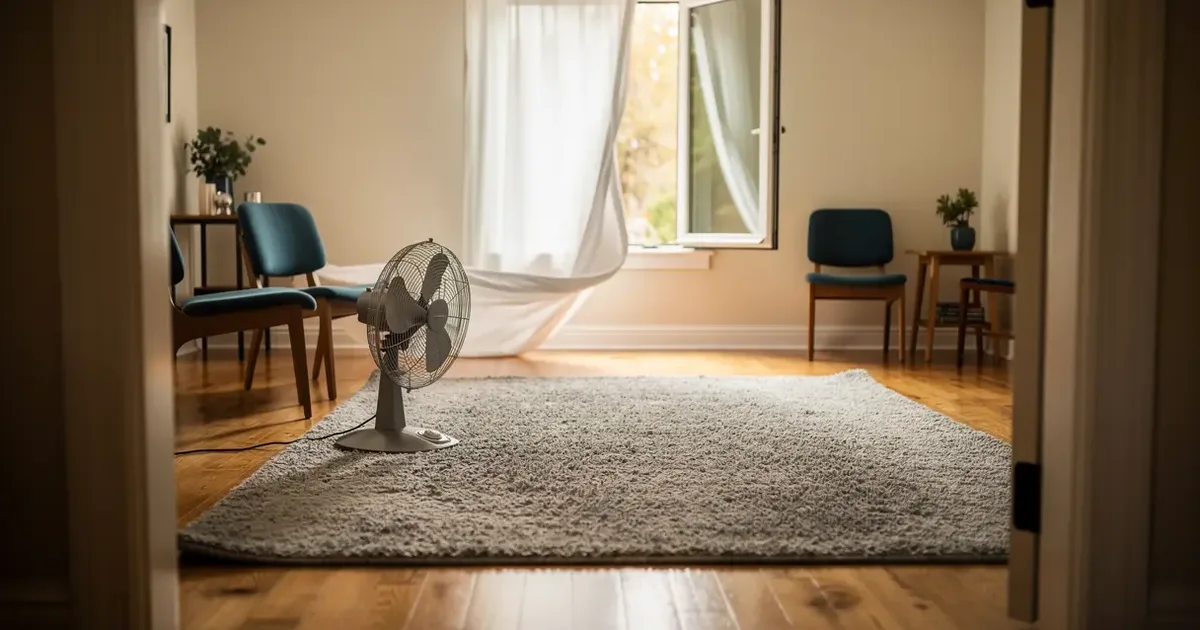
For water damage, the CIUSSS de la Mauricie-et-du-Centre-du-Québec recommends cleaning and drying the premises completely within 24 to 48 hours, otherwise mould can appear (accessed October 2026). The same principle applies, on a smaller scale, to a cleaned carpet: the less water it keeps, the faster it dries. Air out the room, run a fan and avoid walking on the carpet while it is still damp to the touch.
Not knowing the fibre well
Not all fibres react the same way to water, heat and products. Wool, silk, viscose and some hand-woven carpets can shrink or bleed with too much water, water that is too hot or a poorly chosen product. For woven area rugs, the IICRC warns in a tip sheet on area rugs that they can shrink or ripple after a cleaning (accessed October 2026).
Before renting a machine, read the carpet's label and test in a hidden corner, then wait for it to dry before judging the result. A hidden corner is enough for the test.
What a professional cleaning adds
A professional looks at the carpet before cleaning it, then adapts the method to the fibre and the condition of the carpet.
Inspection first. Before we start, we look at the fibre, the condition of the carpet, the high-traffic areas and the marks, then we tell you what is realistic. Some marks come out, others fade, and a few can be permanent. We prefer to say so in advance.
A method suited to the textile. The product is chosen according to the fibre and the type of dirt, and every cleaning follows the same steps: inspection, assessment of the situation, choice of treatment, execution, then evaluation of the results. The detail is in our method.
Drying too. We use a professional extractor and, as needed, professional fans to circulate the air and speed up drying. We always tell you what precautions to take after the cleaning.
Textilo comes to your home, in Sherbrooke and within about 50 km. For wall-to-wall carpet, see also our page on carpet and wall-to-wall carpet cleaning. For an area rug, see our page on area rug cleaning.
Rental or professional: the comparison table
Rental wins on freedom to choose your moment. Professional cleaning has the edge on the other criteria, especially when the fibre is fragile or the carpet is very dirty. According to the Carpet and Rug Institute's residential standard (CRI 205), rental machines suit spots and spills and offer interim cleaning, without replacing the periodic professional deep cleaning.
| Criterion | Rental machine | Professional cleaning |
|---|---|---|
| Timing | You choose when to clean | An appointment to set |
| Your time | Pick up the machine, clean, then bring it back | Prepare the room before we arrive, nothing more |
| Water left in the carpet | Depends on the machine and your technique | Extraction with a professional extractor |
| Choice of product | The product sold with the machine, whatever the fibre | A product chosen for the fibre and the type of dirt |
| Delicate fibres | A real risk if the label is ignored | A fibre inspection before starting |
| Drying | Depends on how much water is left in the carpet, and the carpet pad can stay damp under a dry surface (IICRC) | Fans set up as needed, precautions explained |
| Advice | None, you judge the result alone | A frank opinion on what is realistic for your carpet |
When renting is enough
Renting is a good choice when the carpet is synthetic, lightly soiled and free of stubborn marks, in a room that dries well. It suits mainly these situations:
- the carpet label allows water cleaning, with no particular restriction;
- the dirt is light and even, with no old mark or lingering odour;
- the room is well ventilated, and the carpet can dry without delay;
- you have time to make several suction-only passes after washing.
Follow the manufacturer's instructions first. According to the CRI standard, most manufacturers recommend spraying a product before washing, then rinsing with water only. A few simple steps then limit the risks:
- Vacuum thoroughly before you start, to remove the dry dust.
- Use the dose of product shown on the package, without adding any: a more concentrated solution can leave residue.
- Rinse with clear water if the machine allows it, then make more suction passes than injection passes.
- Air out the room and run a fan until the carpet is completely dry.
When a professional is better
Call a professional for a fragile fibre, a stubborn odour, marks that keep coming back or a large area:
- the carpet is wool, silk, viscose or hand-woven, and the fibre needs an inspection before any water cleaning;
- an odour persists, for example after a pet accident, and our article on pet urine explains why it comes back;
- marks come back after a first try with a rental machine, because the IICRC points out that cleaning does not always remove all the dirt lodged at the base of the fibres;
- the area is large, like a whole floor, or you simply do not have time to rent, clean and return the machine.
Still undecided? Once we open in January 2027, we can tell you frankly whether a rental machine is enough, whether a professional cleaning is worth it and whether we can treat that room. We do not promise the impossible.
Frequently asked questions
Can a rental machine damage my carpet?
It can, especially if the carpet stays too wet or if the fibre does not tolerate water well, like that of a woven area rug. Read the label and test in a hidden corner before treating the whole surface.
Why does my carpet get dirty faster after a home cleaning?
Often, product has stayed in the fibres, and according to the Carpet and Rug Institute, these residues can attract dirt. Rinsing with clear water, followed by several suction-only passes, limits this problem.
How long does a carpet take to dry?
There is no single duration. It depends on the textile, the method, the amount of water used, the airflow and the conditions in the room. According to the IICRC, the carpet pad can stay damp longer than the surface. Good airing and a fan speed up drying, and during a professional cleaning, fans can be set up as needed.
Does a rental machine remove odours?
It can reduce a light odour that stays on the surface. An odour that comes from the carpet pad, like pet urine, needs a treatment suited to its source, and some odours cannot be completely eliminated, even by a professional.